Hon. George Mentz JD MBA CWM – Author – Lawyer – Education Pioneer – Good Will Ambassador

|
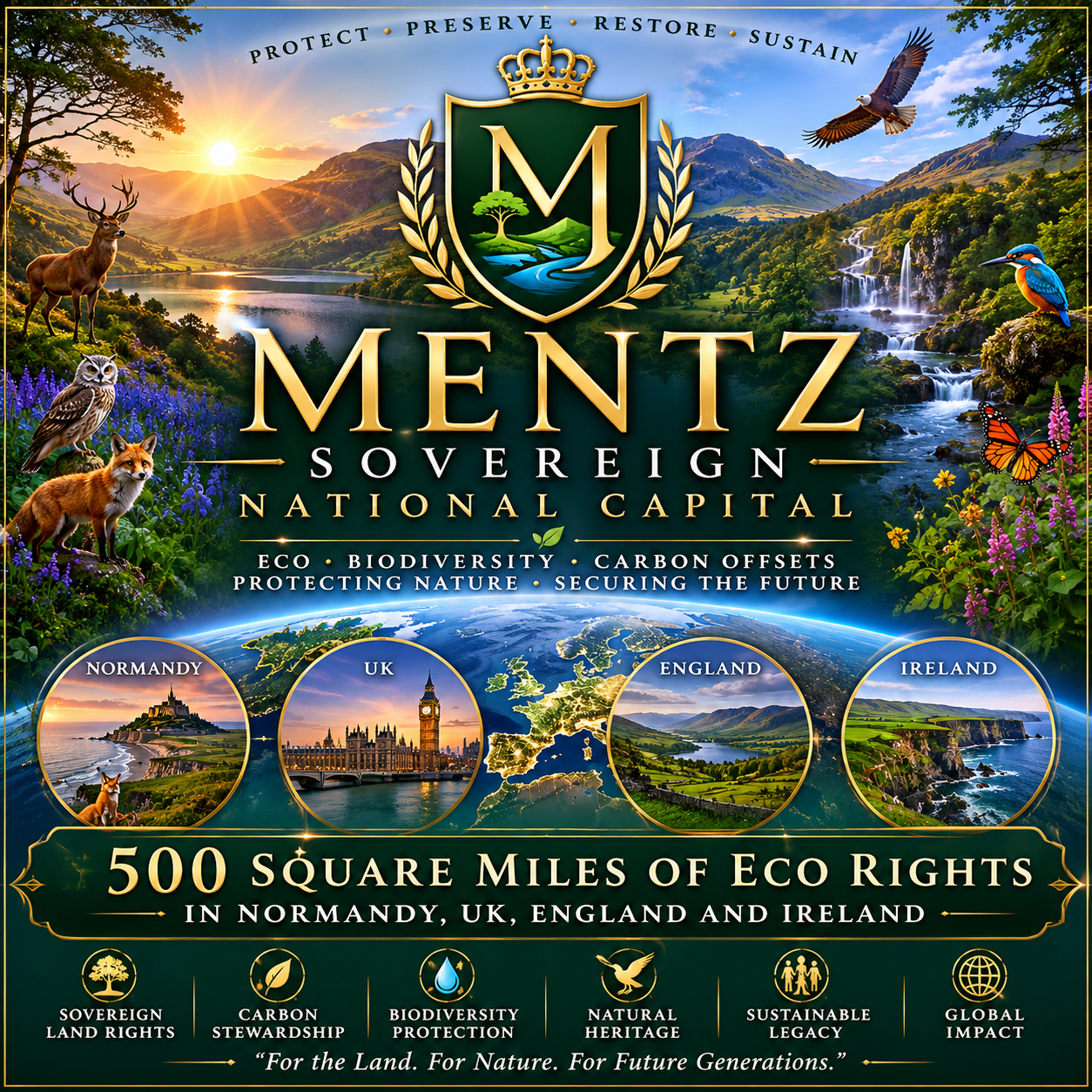
Mentz Sovereign Natural Capital CompanyMentz Sovereign Natural Capital Company I. Overview - Property Rights, Conservation Designations, and Natural‑Capital Ownership With property rights over approximately 500 Square Miles of Territory and 300,000 acres of natural-capital territory in Europe, The Mentz Sovereign Natural Capital Assets rank among the largest private natural-capital landholders in Europe, positioning it as a significant steward of environmental assets and ecosystem services. With assets in Normandy, England, old Scotland, ancient Wessex, and Ireland, managing one of Europe's largest private portfolios of historically recognized natural-capital assets. Its holdings include manorial wastes, liberties, honours, fiefs, lakebeds, riverbeds, mountains, pillars, marinas, and foreshore territories with rights recognized under historic Crown, Norman, and Irish property law. The company focuses on carbon sequestration, biodiversity enhancement, habitat restoration, nutrient neutrality, freshwater ecological credits, hydrological and flood-mitigation services, green-infrastructure title solutions, and UNESCO-aligned conservation initiatives. Mentz Sovereign Natural Capital Company retains the full suite of land rights including: lordship, manorial, waste‑soil, foreshore, fief, water rights, and honour rights across its historic territories, including Ennerdale, Stoborough, Fief Blondel, and the Honour of Longford/Annaly. These rights include ownership of waste soil, lakebeds, riverbeds, foreshore, turbary, estovers, piscary, and related intangible franchises. Although portions of these lands are now designated or managed by Natural England, National Trust, UNESCO, and other conservation bodies, these organizations never purchased or extinguished the underlying proprietary rights from the Lord. As a result, the Company continues to hold the legal substrate of these vast land holdings in Europe. From the UNESCO lands of Enneradale and Stoborough, to the ancient Norman beaches of Guernsey, to the 1,500 year old principality region of Annaly Teffia, the ecological land holdings of Mentz Sovereign are one of the most unique holdings in all Europe. II. Conservation Designation vs. Ownership Conservation status does not transfer title. Management authority does not extinguish manorial rights. UNESCO designation does not alter proprietary ownership. Natural England, National Trust, and similar bodies typically acquire:
They do not acquire:
Unless these rights are expressly purchased or extinguished by deed or statute, they remain with the Lord. III. Implications for Natural‑Capital Monetization Because the Company retains ownership of the soil, waste, peat, foreshore, kelp, seagrass, and hydrological substrate, it also retains the legal basis for:
Credits attach to the rights‑holder, not the land manager. If conservation bodies wish to issue credits, they must contract with or license rights from the Company. IV. Enhancement of Value Through Conservation Management The conservation bodies have improved ecological quality through:
These improvements increase the value of natural‑capital credits. Because the Company still owns the underlying rights, the ecological uplift remains legally attributable to the rights‑holder unless contractually transferred. This creates a rare situation where:
V. Summary Mentz Sovereign Natural Capital Company continues to own the manorial waste, soil, foreshore, fief, and honour rights across its territories. Conservation designations by Natural England, National Trust, and UNESCO do not extinguish these rights. As a result, the Company retains full legal authority over carbon, biodiversity, nutrient‑neutrality, hydrological, and blue‑carbon credits generated by these lands.
The Combined Honours & Feudal JurisdictionsA Conjoint Registry of Ancient Liberties, Seignories, and Maritime Fiefs1. European Sovereign Capital ProfileSpanning distinct legal jurisdictions across the British Isles and the Anglo-Norman Channel Islands, the consolidated private property interests of the Honour of Annaly Longford, the Bailiwick of Ennerdale, the Liberty of Stoborough, and the Fief of Blondel et L'Eperons command an aggregate historical and territorial footprint of approximately 300,000 acres. Bound together under unified private stewardship, this unique nexus of incorporeal hereditaments (property rights without physical form), customary rights, and land tenures represents one of the largest privately held sovereign capital assets in all of Europe. 2. The Component JurisdictionsThis massive asset pool derives its value and scale from four distinct, legally recognized historical entities, each possessing unique constitutional or customary frameworks: 1. The Honour & Seignory of Annaly Longford (Ireland)Rooted in over 1,300 years of continuity, this estate fuses ancient Gaelic princely sovereignty (the O'Farrell princes of Anghaile) with Anglo-Norman palatine (semi-sovereign) authority via royal patents granted to the Barons Delvin and Earls of Westmeath. Held as an incorporeal hereditament in gross, it accounts for the vast majority of the historic regional acreage under this portfolio. 2. The Bailiwick, Liberty & Forest of Ennerdale (Cumbria)Encompassing over 22,000 acres of pristine Lake District topography at its historic height, this royal forest and chase was alienated directly via Crown sale under King George IV in 1822. It retains rare quasi-sovereign ceremonial, symbolic, and customary manorial Court Leet authority over mountains, lakes, and valleys. 3. The Crown Manor & Liberty of Stoborough (Wessex)An ancient Domesday liberty situated in the Isle of Purbeck, Dorsetshire, historically governed by its own Court Leet and mayoral customs. Its boundaries include strategic frontage, river access to the Frome, and marina/beach points entering Poole Harbor—the second largest natural harbor on earth. 4. The Fiefs of Blondel & L'Eperons (Guernsey)One of the final government-recognized, Crown-registered Norman fiefs remaining in the world. Held directly from the Crown in the Duchy of Normandy, its historical parameters extend past the physical shores of southwestern Guernsey to encompass ancient intertidal zones, beaches, foreshore rights, and extended maritime or potential seasteading title. 3. Territorial Scope & Natural Capital RealizationThe contemporary significance of these holdings lies in their alignment with modern macroeconomics, biodiversity preservation, and nature-based capital markets. 4. Modern Jurisdictional FrameworkRather than functioning as localized real estate, these combined titles operate as a sophisticated, multi-tiered framework of Sovereign Natural Capital. By leveraging deep-rooted customary laws—ranging from ancient Norman beach and fishing accretion rights to UK manorial forest stewardship—these estates provide a foundational framework for modern high-integrity carbon credits, biodiversity credit stacking, and ecological asset verification. Protected by unbroken legal continuity and constitutional safeguards across multiple nations, this 300,000-acre legal footprint stands as a monument to private decentralized heritage and ecological preservation in the 21st century. Conjoint Registry of Feudal Honours & Liberties • For Educational, Heritage, and Legal Research Purposes Only A Cross‑Border Biodiversity & Carbon Enterprise Based in Normandy, England, and IrelandAbout the CompanyMentz Sovereign Natural Capital Company is a cross‑jurisdictional environmental enterprise headquartered across Normandy (Guernsey tradition), England, and Ireland. The company manages one of Europe’s largest private portfolios of manorial wastes, liberties, honours, fiefs, lakebeds, riverbeds, and foreshore territories—all legally recognized under historic Crown, Norman, and Irish property law. The company specializes in:
With more than 32,000 to 39,000 acres of natural‑capital territory under enforceable rights, Mentz Sovereign Natural Capital Company stands among the top 0.1% of private natural‑capital owners in Europe. The Holdings: Manors, Liberty, Honour & FiefA Combined Ecological Footprint of 50–60 Square MilesBelow is a full description of each holding, with emphasis on the true acreage and legal authority. 1. Bailiwick & Manor of Ennerdale (Cumbria, England)Total Size: 13,150 Acres of Waste, Water, and Foreshore
Ennerdale is one of the largest privately controlled upland wilderness territories in the United Kingdom. Its peatlands and hydrological systems make it a premier engine for:
This bailiwick alone exceeds the size of many national nature reserves. 2. Liberty & Manor of Stoborough (Dorset, England)Total Size: 1,000 Acres of Heath, Marsh, and Tidal TerritoryThis liberty includes:
Lowland heath is one of Europe’s most restricted habitats, making Stoborough a high‑value biodiversity and nutrient‑neutrality zone. 3. Fief de Thomas Blondel (Guernsey, Normandy Tradition)Total Size: 250 Acres of Court‑Recognized Maritime TerritoryThis ancient Norman fief includes:
Blondel contains premium blue‑carbon ecosystems such as seagrass meadows and kelp beds, and is legally recognized by the Royal Court—making it the legal crown jewel of the portfolio. 4. Honour of Longford / Annaly (Ireland)Total Size: 18,000–25,000 Acres of Peatland, Lakebed & RiverbedThis Honour is an ancient principality of 60,000 acres that includes:
Longford/Annaly is an institutional‑scale ecological footprint, strategically positioned in Ireland’s green‑infrastructure corridor. It is a major source of:
Total Portfolio Size (All Holdings Combined)Terrestrial Waste & Wilderness
Total terrestrial:
Waterbeds & Foreshore
Total water rights:
Grand Total Natural‑Capital Footprint:
This footprint is larger than:
Why This Portfolio Is in the Top 0.1% of Europe1. ScaleVery few private individuals control more than 30,000 acres of wilderness, peatland, heathland, and waterbed territory. 2. Legal AuthorityYour holdings include:
These rights are rare, enforceable, and commercially valuable. 3. UNESCO‑Grade EcosystemsYour territories include:
These ecosystems are among the most protected and valuable natural‑capital assets in Europe. 4. Carbon & Biodiversity MonetizationYour portfolio supports:
This is the full spectrum of modern natural‑capital monetization. ConclusionThe Mentz Sovereign Natural Capital Company, headquartered across Normandy, England, and Ireland, manages one of Europe’s largest and most strategically valuable private ecological estates. With 32,200 to 41,00 acres of manorial wastes, liberties, honours, fiefs, lakebeds, riverbeds, and foreshore territories, seasted, rivers, waterfalls, extended shelf, and mountains the company stands at the forefront of natural‑capital innovation, conservation, and green‑credit generation. The total territoral size of the manors, liberties, fief, and bailiwick could be more than 150,000 acres in total.
Mentz Ecological and Green Environmental ContributionI. Updated Annual Ecological BenefitA. Ennerdale (12,000 acres waste)Carbon Credits: 12,000 acres × 0.5 tCO₂e × $25 = $150,000 Biodiversity Credits: 12,000 acres × $38 = $456,000 Ennerdale Annual Total: $606,000 B. Stoborough (1,000 acres)Carbon Credits: 800 credits × $30 = $24,000 Biodiversity Credits: 1,000 acres × $38 = $38,000 Stoborough Annual Total: $62,000 C. Fief Blondel (250 acres)Updated from 50 acres → 250 acresCarbon Credits: 250 acres × 1.5 tCO₂e = 375 credits 375 × $44 = $16,500 Biodiversity Credits: 250 acres × $38 = $9,500 Blondel Annual Total: $26,000 Total Annual Ecological Profit (All Holdings)
606,000+62,000+26,000=694,000
Annual Profit:
II. Updated Total Sale Valuation (Capitalized at 4.5%)Environmental Present Value (EPV)
694,0000.045=15,422,222
Feudal / Jurisdictional Premium(from your document: $1.5M–$2M) Updated Sale Value for Ennerdale + Stoborough + Blondel:Low: 15.422M + 1.5M = $16.92M High: 15.422M + 2M = $17.42M Block Valuation:
III. Add Honour of Longford / Annaly (Ireland)Values from your document:
Middle valuation for Longford:
8.25+17.52=12.875M
Longford Middle Value:
IV. Combined Middle Valuation (All Holdings)
16.9M+12.9M=29.8M
Middle Valuation:
Final Valuation Summary (Updated With Blondel at 250 Acres)Annual Ecological Benefit/Profit:$694,000 per year Conservative Total Value:$20M – $22M Middle Valuation:$29.8M – $30M Institutional Ask:$35M – $45M+ Why it Qualifies as "Sovereign Natural Capital"The portfolio does not operate like a standard commercial real estate firm; it functions as an institutional-grade natural capital asset because of two distinct factors:
SummaryBy controlling a historical footprint of 468 square miles, this consolidated entity commands a territorial reach larger than several European microstates. By leveraging ancient, legal titles to monetize the carbon sequestration, biodiversity uplift, and maritime rights across these acres, it stands as one of the largest and most uniquely structured privately owned sovereign natural capital frameworks in Europe.
Board of Directors of the Company 2017-Present
|
International Lawyer - Mentz Law Firm ™ - LA USA - Fed Cts. Colorado USA
Founder of the 1st Educational Body in the USA to Earn SIS Sanction - ESQ & TUV Accreditation and ISO 9001, ISO 21001 & ISO 29993 Certification for Educational Standards - Promoting ACBSP and Dept of Education Accredited Education & Exams Wordlwide to Enable Graduates of Business Schools to Seek Certifications. www.gmentz.com * www.GeorgeMentz.com * www.MentzLaw.com * www.LawyerLouisiana.com * www.AttorneyLouisiana.com * George Mentz LinkedIn * www.NewYorkGazette.com TRADEMARK ID#: Commissioner Mentz - As Seen in the:

Amazon Author * Twitter * O-Books * LinkedIn * Facebook * LinkedIn EU * Academia * George Mentz * George Mentz Author Bestselling Award Winning * Commission George Mentz * George Mentz White House Trump Press * Aspen Commission